

A chairde!
This week we learned about a professor’s Michael Byram’s model of Intercultural Communications (1997). Now I know this theory is older than most of us but I think this guy made some really interesting observations and points that are still very much relevant today. Instead of explaining it and using up my word count I’m going to pop an illustration down below. (As we learnt from my Language Learning Blog, I’m partial to the odd graph or illustration)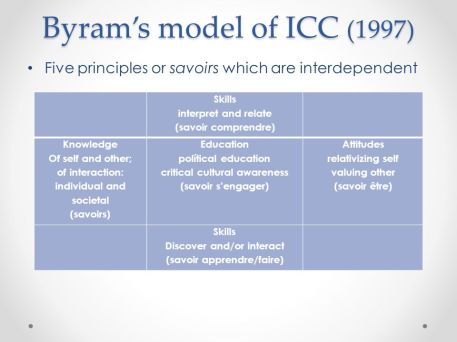
During our tutorial a question was posed: “What would be a good definition for an intercultural mediator”. After a quick search I found an interesting article which defined a language teacher as being the ultimate language mediator. (Clouet, 2006: 53-62)
I thought this tied in well with what I learnt last year about language and culture being practically inseparable. Naturally, all five principles or savoirs need to be utilised in tandem with each other in order to communicate with other cultures effectively. I can clearly see how language teachers utilise savoir comprendre and savoir s’engager on a day to day basis. I think that savoir étre (the attitudes of relativizing self and valuing other) is definitely what I find most challenging and almost tiresome at times.
In a study of the compulsory year abroad many of us language students are required to participate in, Byram and Alred remark that experiences of the students:
“Became a process of temporary re-socialisation into a foreign culture and it’s practices and beliefs” (Alred and Byram, 2002: 340)
As someone who spent a year abroad before coming to college (and will again spend almost half of my degree in a foreign country) I can totally relate to the idea of “temporary re-socialisation”. It took me many weeks of receiving dirty looks on escalators before I realised that in Germany (and most of mainland Europe apparently) you’re supposed to stand on the right hand side so that those in a rush can pass you out on the left! This sort of sensible thinking has just never occurred to us Irish. An example like this accurately reflects the different cultural attitudes found in different countries. You could even relate this to how in Ireland we’re at least 15 minutes late for everything (maybe that’s just me)
Slán tamall!
Saoirse x
Alred, G. and Byram, M., 2002. Becoming an intercultural mediator: A longitudinal study of residence abroad. Journal of multilingual and multicultural development, 23(5), pp.339-352.
Byram, M., 1997. Teaching and assessing intercultural communicative competence. Multilingual Matters.
Clouet, R., 2006. Between one’s own culture and the target culture: The language teacher as intercultural mediator. Porta Linguarum: Revista internacional de didáctica de las lenguas extranjeras, (5), pp.53-62.
 Saoirse Cainte
Great post Saoirse. The five savoirs are very important to know and be aware of as language students. I liked your observation on how language teachers use savoir comprendre and savoir s’engager on a daily basis. They definitely have a responsibility to know how to make languages easier to understand for students. It was also interesting to read about your cultural experience in Germany. I’ll be going with very limited knowledge of little cultural nuances next year when I go on Erasmus to France, I guess I’ll just have to experience it for myself and learn from any mistakes that I make.
LikeLike