

Hola mis amigos!
Today I want to talk a lil bit about Corpus Linguistics. According to my lecturer (shout out to Sylvia) this idea of corpus was introduced all the way back in the 60’s however I only heard the term for the first time last Monday.
“Corpus linguistics makes it possible to identify the meanings of words by looking at their occurrences in natural contexts rather than relying on intuitions about how a word is used” (Biber et. al, 1998)
If like myself you are still o so very confused hopefully  this post will clear some things up for you. As I understand it a corpus or corpora (plural) is a -typically- large but finite body of text that lets us see the frequency and the context words are used in. These corpora can be searched for a specific word and used to formulate a concordance or:
“a collection of the occurrences of a word-form […] in its own textual environment” (Sinclair, 1991:320)
Fun fact: A corpus can be a collection of written OR spoken texts.
But what is this used for? That’s a great question and I’m glad you asked! First off, all the way back in the 1775 Samuel Johnson created a corpus to publish the first official English Dictionary. It that wasn’t enough to convince you of its importance it is also used in language teaching and learning and has been incorporated into many CALL apps in the past few years. (Harris, et. al, 2010)
” it require learners to categorise words, phrases or sentences, or to identify common factors, which certainly encourage noticing skills and language awareness” (Harris, et. al, 2010. pg. 27)
When it comes to foreign language acquisition, analyzing samples of your chosen language in a genuine text and natural context helps make sense of HOW those words are used in everyday speech and writing. For example, using prepositions in their correct context is a daily struggle for those learning a foreign language. If you were not exposed to or taught said language as a child, prepositions will not come naturally to you and instead have to be learned and observed. That’s where concordances like Antconc step in! With a click of a button you have access to multiple examples of your chosen preposition being used correctly in a variety of contexts. Here’s a lil illustration.
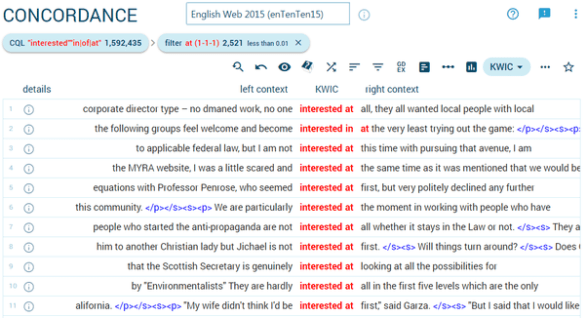
Again you could use examples like “to do” or “to make”. In English we know these as two separate verbs. However in Spanish, German and Irish (and probably many more languages) to do and to make are the same verb (hacer, machen & déan). This I’m sure must lead to confusion among English learners. Once again Antconc provides a perfect solution, allowing you to list and sort through the various contexts and uses of these verbs.
I hope this made some sort of sense, or was at least an entertaining read in any case. I know I’ll be make use of a concordance or two while preparing for my German and Spanish exams this Christmas (help). If you’ve found any other helpful uses with regards corpora in your language learning career please comment down below so I can steal your secrets.
Slán tamall,
Saoirse x
References:
Biber, D., Conrad, S., Reppen, R. (1998). Corpus Linguistics: Investigating Language Structure and Use. Cambridge University Press.
Harris, T., Jaén, M. (2010). Corpus Linguistics in Language Teaching. International Academic Publishers.
Sinclair, J. (1991) Corpus, Concordance, Collocation. Oxford: Oxford University Press.
 Saoirse Cainte